We use LFP for long lifetime, cheap and safe systems; NMC and NCA for higher current rates and higher energy density; and LTO for low-temperature performance, great aging behaviour, and very high charging rates. Done?
Real battery selection is not that straightforward, because the right chemistry depends on how the battery will actually be used: real world cycle, peak and continuous power, charging profile, operating temperature, expected service life, system safety concept, and total cost all matter.
Even the common assumption that LFP always leads to the safest battery system is not universally true. At cell level, LFP often has some clear safety advantages, but at system level, safety depends on far more than chemistry alone.
Pack design, propagation resistance, venting strategy, thermal management, fault detection, and installation conditions all influence the final risk profile. And a good chemistry choice is therefore only half of the decision. In practice, chemistry choice and supplier choice go hand in hand, because even a strong chemistry can become a weak product if supplier quality, consistency, and engineering support are poor, or if the integration into modules and packs is carried out sub optimally. So basically, you should not only chose a suitable chemistry, but also a good supplier. If your job is to integrate cells into modules/packs you need a lot of knowledge. If integration isn’t your job and you just buy, you still need the capability of finding a good module/pack manufacturer, if your business success shall not depend too much on luck. In the real battery world, procurement and sales people often lack critical knowledge and it is not a good sign if asking a simple (!) technical question to a sales guy leads to the answer “I need to check with the technical guys”, and it is even worse when the technical guys’ answer is unsatisfying. But I do not want to complain too much about experience with sales guys, because I also experienced the opposite case that a company offers a great battery system (potential great fit for the customers’ application) the sales guy is some former technical guy with deep technical knowledge, but the procurement on the other side of the table is not able to deeply understand why the system is that great, and of course then again they need to check with the technical guys.
Why chemistry selection is not straightforward and where money is lost
Many teams begin battery selection by comparing headline values such as energy density, cycle life (based on lab tests, which are mostly irrelevant anyway), or cost per kilowatt-hour. A chemistry that looks excellent on paper may create difficulties once it is exposed to the actual load profile, ambient conditions, charging behaviour, safety requirements, and mechanical limitations of the target product.
Ok, so there is a difference between the performance of a cell and performance of a cell in a pack in the real world. That is clear. There is also a difference between a cost of a cell and a cost of a cell in a well-designed pack. The cost of a well designed module/pack at the beginning of life is important, but the total cost of ownership is way more important and project parameters like expected lifetime are critical. When you have a cheap BESS system but the batteries are done after 5 years – and not as planned after 15 years, you get into trouble and suddenly it is not as cheap anymore.
Now, how do we build systems that last long? Choosing a good chemistry from a good supplier AND testing it. Testing is not comparing irrelevant data from sales brochures, testing means testing the cells with a power profile and environmental conditions according to your application. And this is where a little money can be saved upfront and a lot of money can be lost later. When setting up a test plan to test the battery cell according to a power profile in a real application, sometimes it is not that easy to define a operating profile in the real application, because there can be uncertainties, like for example weather conditions / waves determining the power need from the battery for electrified ships. But you can always define some worst case scenarios with the help of an expert.
Finally, a single cell being the best in different tests is not enough. You need a supplier that can provide this kind of cell reliably, with only small differences in capacity and internal resistance. This was more of an issue 10 years ago, when cells coming from production lines could have quite a spread in terms of capacity and internal resistance. These days, manufacturing quality has improved drastically, but uniformity should still be tested and confirmed.
Start with the application
A practical battery selection process should begin with the application requirements. Before comparing chemistries, the team should define what the battery must actually do in the end product.
Key questions include:
· How much energy is required?
· What are the peak and continuous current/power demands?
· How often will the battery cycle?
· What service life is expected?
· What temperatures will the system experience during operation?
· How much space is available and what is the maximum weight?
· What kind of safety margins are required?
· Which standards, certifications, or customer requirements must be met?
· Is the design optimized for minimum upfront cost or minimum lifetime cost?
Chemistry choice and supplier choice go hand in hand
Two suppliers may both offer cells sold as LFP, NMC, or NCA, yet the real-world performance may differ significantly. Additionally, cells can be optimized in different ways during manufacturing and even cells of the same chemistry from the same manufacturer can be different and one may be optimized for power and another one for energy.
Variations in raw material quality, electrode coating uniformity, electrolyte formulation, formation process, quality control, and overall manufacturing consistency can all affect for example cycle life, impedance growth, and safety consistency.
This means chemistry defines the theoretical potential, but the supplier determines how reliably that potential is realized.
That is why chemistry choice and supplier choice must be handled together. The right questions are:
· Which chemistries fits the application?
· Which supplier can deliver this chemistry with stable quality, stable quantity, and at a reasonable price?
· Who can support validation, scaling, and technical documentation?
· Who has proven manufacturing maturity and traceability?
· Who can support the project during design iterations and after launch?
Candidate selection is only the beginning
Another part of battery selection that is often underestimated is verification. Choosing a chemistry and a supplier does not yet mean the right battery has been found. At that stage, the team usually has only identified the most promising candidates for the application. And I saw data, when the most promising candidate was the worst in the field and the other way around. That much about standard sales brochures.
The shortlist must then be challenged through additional testing. Cells, modules, or complete systems need to be evaluated under realistic operating conditions. Of course, laboratory conditions rarely match real-world operation, and that module- and pack-level aging is more complex than single-cell behaviour.
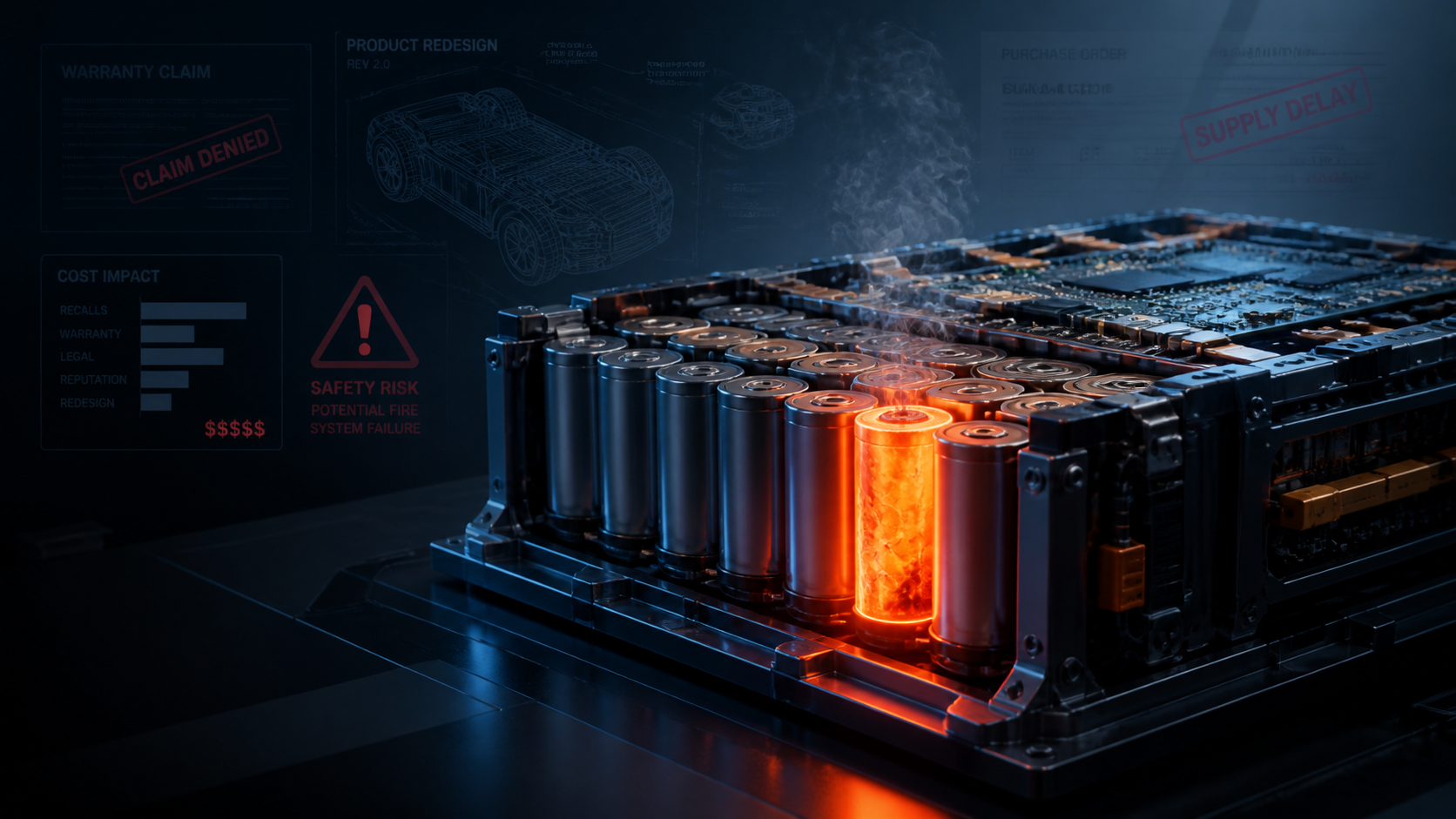
This is where many companies move too fast. Once a promising candidate appears commercially acceptable, there is often pressure to finalize the selection and keep the project moving. But in battery systems, underestimating validation is a serious mistake. And it is one of the mistakes that can cost a lot of money or even lead to bankruptcy.
Procurement and sales incentives matter more than most teams admit
One issue that many companies do not want to discuss openly is incentives. Battery systems are often specified for 10 or 15 years of operation, but many of the people involved in selecting and buying them will not be accountable for that full lifetime. If a system designed for 15 years begins showing serious problems after 8 years, the procurement manager who pushed for the deal may already be in another role, at another company, or far enough from the original decision that the consequences no longer affect them directly.
That creates a structural problem. In some organizations, procurement is rewarded more for meeting the short-term budget or finalizing the project on schedule than for ensuring that the battery system truly delivers long-term reliability. In that environment, the easiest decision is often not the best technical decision. It is the decision that gets the contract signed, the project completed, and the immediate commercial pressure removed.
The same applies, and often even more strongly, to sales teams. Sales teams have a clear job: to sell. In many cases, they are also financially rewarded for closed deals through commissions or other performance incentives. That means their interests are naturally aligned with winning the order, not necessarily with finding the best long-term battery system for the customer. Some salespeople are transparent about this in private, but the public message sounds a bit different.
This does not mean every procurement professional is careless or every salesperson is untrustworthy. It means the incentive structure must be understood for what it is.
A proper evaluation should include questions such as:
· How technically competent is the seller?
· Can they explain failure modes, degradation mechanisms, and system limitations clearly?
· Are they transparent about trade-offs, or only emphasizing strengths?
· What happens after commissioning if problems appear years later?
· Is the suggested life cycle agreement worth the paper it is written on, or does it apply only under conditions that are not a realistic scenario. This can be very tricky and many LCAs are signed without proper assessment by a technical expert.
What procurement teams should prioritize
Procurement teams are often measured on purchase cost, but battery sourcing decisions need a broader view. The lowest-cost cell can become a high-cost choice if it leads to inconsistent quality, certification delays, warranty exposure, or field failures.
Procurement should therefore assess not only price, but also consistency, test evidence, process transparency, test documentation quality, production maturity, warranty terms, and responsiveness. These factors are especially important in many battery projects where switching suppliers after product integration is expensive.
Really good procurement teams work closely with engineering during chemistry and supplier selection, or get technical qualifications themselves through educational programs like BattXcel.
Final perspective
Choosing the right Li-ion battery chemistry for an application is about much more than comparing LFP, NMC, NCA, or LTO in isolation. Each chemistry has its own area of strength: LFP for long-life and thermally robust systems, NMC and NCA for higher energy and performance, and LTO for exceptional charging speed and low-temperature operation. But the final answer which chemistry-supplier-combination to chose always depends on the real duty cycle, the installation environment, the safety concept, the quality of the supplier, and the evidence from verification testing.
The strongest teams approach battery selection with three disciplines. First, they define the application clearly enough to know what the battery must truly deliver – not only in the beginning, but also at the end of life. Second, they evaluate chemistry and supplier together. Third, they treat testing as necessity rather than a formality, because in long-lifetime battery systems, wrong assumptions are expensive and validation is essential.
Legal Disclaimer
The information provided in this article is for general informational purposes only and represents a personal view. All information is provided in good faith; however, Greenectra OÜ makes no representation or warranty of any kind, express or implied, regarding the accuracy, adequacy, validity, reliability, availability, or completeness of any information.
Under no circumstances shall Greenectra OÜ be held liable for any loss or damage of any kind incurred as a result of the use of this information or reliance on any information provided. Your use of this information and your reliance on any information is solely at your own risk.