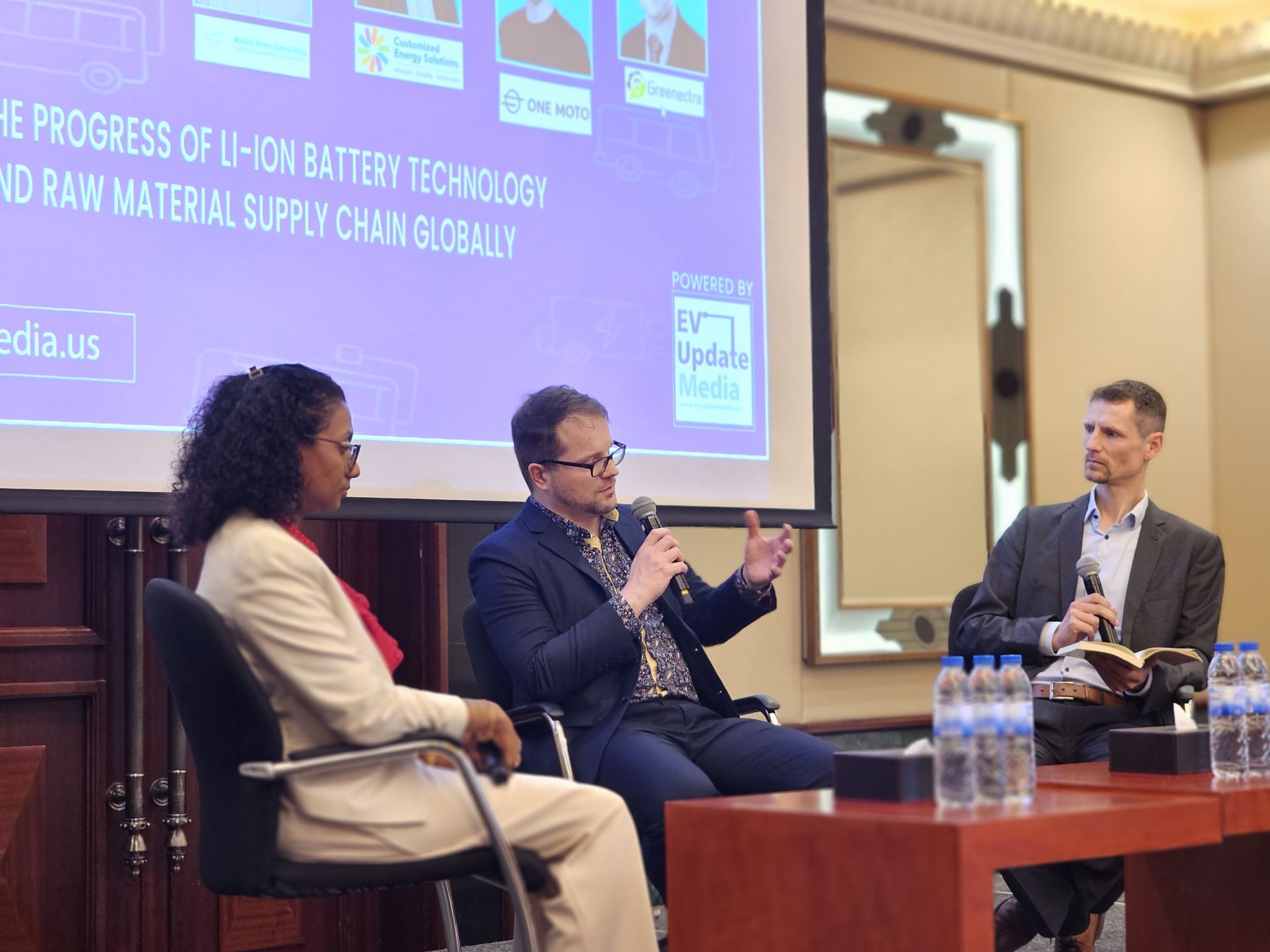
Over the past months I travelled through the United Arab Emirates, Thailand and China, and the insights below come directly from the conferences, workshops and meetings I had with project developers, manufacturers, investors and policymakers. In January, I spoke at the EV & Battery Update – Global Meet 2026 in Dubai, in February I taught at a 2‑day BESS workshop for project developers in Bangkok, and in March I presented common pitfalls in Battery Thermal Management and Aging Prediction in BESS at the ASEAN Smart Energy & Energy Storage Expo & Summit 2026, also in Bangkok.
What almost everyone still underestimates
Across Europe and ASEAN, I keep seeing the same fundamental misconception: many people still think choosing a BESS is a rather simple procurement decision, not a complex engineering exercise. System developers and planners feel quite comfortable talking about PCS efficiency, cable losses and inverter topologies—but when we move to the losses in the battery, the level of understanding drops sharply.
Many stakeholders assume that “the BESS experts” somewhere in the supply chain will solve the hard problems. In reality, even those technical teams often lack a deep grasp of aging behaviour, thermal constraints and how specific use‑cases reshape the risk profile. This is why I argue so strongly for targeted education not only for engineers, but also for project developers, financiers and policymakers.
Why brochure aging tests mislead – and the exceptions
A recurring topic in my February workshop and in side meetings at conferences was the gap between brochure aging tests and real operating profiles. The typical aging curve in a sales brochure is generated under very standard conditions: moderate temperature, regular cycles at constant power or contant current, no grid disturbances, no long idling at high state of charge.
When these lab‑based curves go straight into project models, the result is predictable: energy throughput and lifetime are overestimated, losses are underestimated, and later everyone is surprised that year‑10 performance looks more like the “worst case” than the “expected case.” This is not bad luck; it is bad input data paired with insufficient technical scrutiny.
I also make a point of stressing that the story is not one‑way “lab good, field bad.” There are some well‑documented cases where real‑world operation has produced “slower” degradation than traditional constant‑current lab tests, with cases in which batteries in the field operating under a dynamic power profile lasted even up to roughly 30–40% longer than their counterparts in the lab. But these results come from very specific configurations/operating profiles and they are interesting as standalone examples, but not a rule we can generalize to stationary BESS, especially in hot climates with aggressive cycling. Using these examples as proof that “field is always better than lab” would be just as misleading as believing optimistic brochure curves.
In many BESS projects the operating profile is genuinely hard to predict—markets change, dispatch strategies evolve, and grid conditions are not fully known—so setting up meaningful aging tests is not something you can do with a few simple assumptions on a whiteboard. In these cases, specialist support is valuable precisely because it helps define realistic but demanding worst‑case scenarios and translate them into test protocols. The difficulty of prediction must not become an excuse to fall back on generic lab tests, declare them “wrong” and then just add an arbitrary safety margin; instead, we should aim to design test profiles that are as close as possible to expected operation, informed by realistic stress cases, and then add a transparent safety margin to cover the remaining unpredictability
Aging and thermal management: the real pitfall in ASEAN
In ASEAN we have an additional layer: a specific climate. High ambient temperatures, humidity and sometimes limited space make thermal management absolutely central to safety and performance. If the thermal design and operating window are designed wrong, the batteries age faster, round‑trip efficiency deteriorates, and the probability of thermal events increases at the same time.
At ASEE 2026 I talked on precisely these pitfalls like undersized cooling, uneven temperature distribution between racks, good thermal models but wrong parametrization. These are not exotic edge cases; they are common design patterns we can see again and again when talking to operators in both Europe and ASEAN.
Why professional support is not optional
The honest conclusion from these travels is simple: without professional BESS expertise on the project team, the probability of a sub‑optimal or even unsafe system is unacceptably high. You cannot compensate for a weak battery concept with a strong PCS design; you cannot fix a fundamentally wrong operating strategy with a few SCADA tweaks later.
Education is the bridge here. When developers, investors and policymakers understand at least some basics of chemistries, degradation mechanisms, thermal limits and grid interaction, they immediately start to see where they need deeper specialist support—and they become much better at challenging some suppliers’ simplified narratives. This kind of technical education also limits the need for consulting.
The questions I now always ask – and you should ask yourself
I encourage every project team—whether in Europe, ASEAN or China—to start with a short list of uncomfortable questions that I also use in my talks and workshops:
– Do you want 15 years of operation guaranteed by a manufacturer on paper, or actually in the field?
– If the project is designed for 15 years, do you benefit if the system lasts 16, 17 or 18 years?
– Who has real “skin in the game” if performance falls short: the supplier, the EPC, or only the project company and its lenders?
– Are we relying on generic standards in the contract, or have we adapted them to our specific climate, grid conditions, cycling pattern and safety requirements? (mainly relevant in ASEAN)
These few questions already change the tone of discussions. Once people realise how much is not covered by the brochure or the standard warranty, they also realise why serious BESS expertise—and serious education—are non‑negotiable parts of any storage project.
Legal Disclaimer
The information provided in this article is for general informational purposes only and represents a personal view. All information is provided in good faith; however, Greenectra OÜ makes no representation or warranty of any kind, express or implied, regarding the accuracy, adequacy, validity, reliability, availability, or completeness of any information.
Under no circumstances shall Greenectra OÜ be held liable for any loss or damage of any kind incurred as a result of the use of this information or reliance on any information provided. Your use of this information and your reliance on any information is solely at your own risk.